Call It What It Is: Femicide
Yesterday was Mother's Day. And yesterday Katie Olson-Hartley and her two children breathed for the last time.
Yesterday I woke slowly at 5:45 in the morning. I stretched my body. Brewed coffee. I sat on my back steps and watched the sun rise. I breathed fresh spring air deep into my lungs. I listened to the sounds of morning coalescing around me and felt grateful to be alive. There's a new nest tucked in the eave of the house next door. Baby birds squawked in delight as their parents returned again and again with food. The maple leaves moved in the morning breeze.
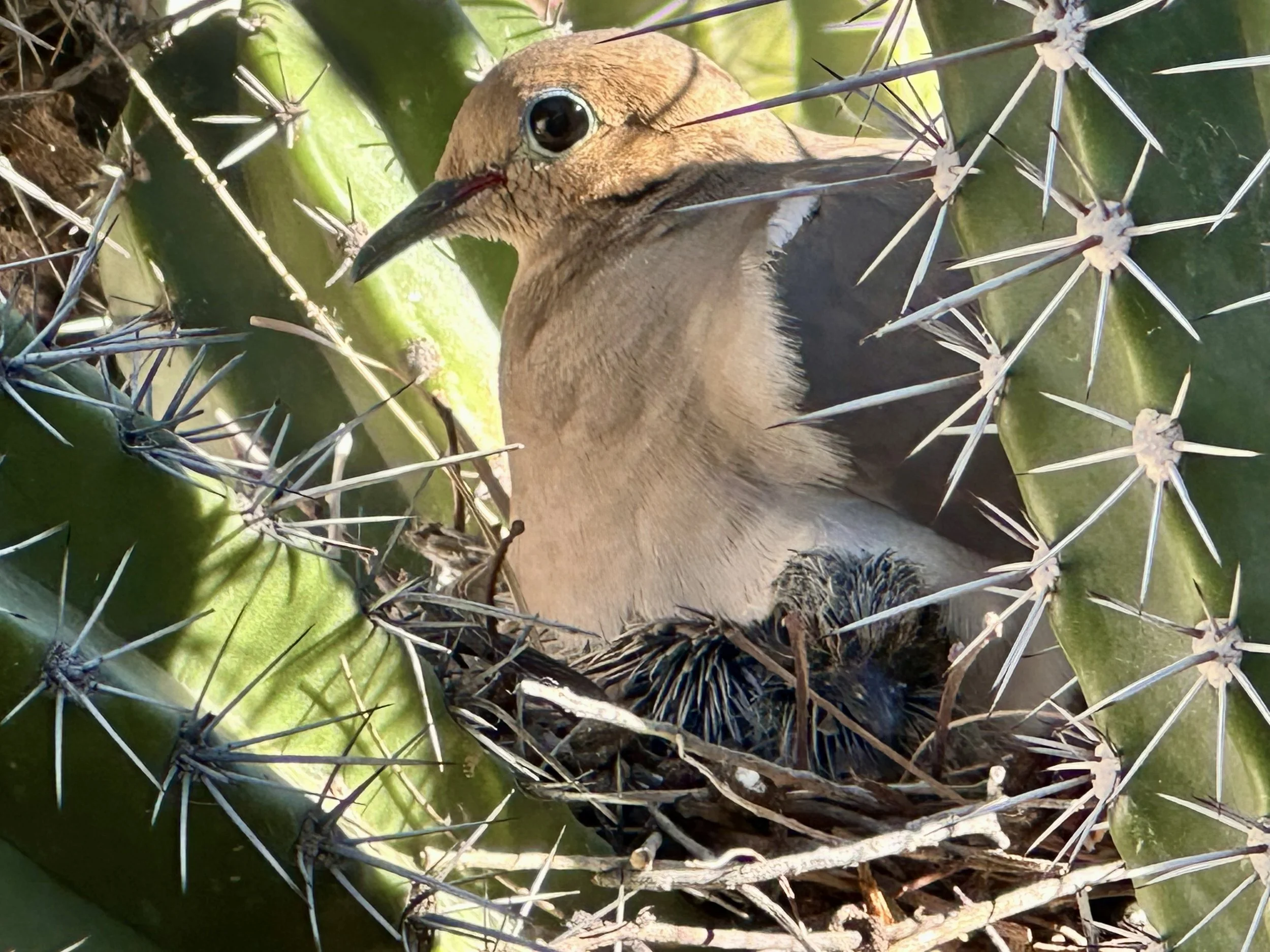
Mourning Dove and chick in a nest in my father’s backyard in Arizona. Nestled safely among the cactus spines.
And just fifteen minutes away, while I sat surrounded by life, a 33-year-old man murdered his 27-year-old wife and their two young children, 6 years old and 7 months old, before turning the gun on himself. It's a familiar story. We hear it every day. This will be called a mental health issue, a catch-all phrase that encompasses everything from nail-biting and anxiety to psychotic breaks and murder. But I studied this. I devoted my every waking moment to intimate partner violence for two years. I wrote my master's thesis on this very topic. I have lived it. And I know that three women a day in the United States are killed by a current or former partner.
Three a day.
That's nearly 2,000 women a year. We need to let go of the mental health rhetoric and name it what it is:
This is femicide.
This is infanticide.
This is family annihilation.
This is a mass shooting.
This is male violence.
This is patriarchal violence.
We do not need more softened language. We need to look directly at the truth and say it again and again until we fill the silence with our voices.
We live in a system that tells men they are entitled to the ownership of women and children.
A system that is set up so that those same men see women and children as objects to possess.
A system that teaches that men's need for control is natural. That their anger is legitimate. That their rage is the only justified emotion. That if they cannot possess their partner, then no one will.
The witch trials have never really ended. They just morph and change shape with the age, but the outcome is the same: women punished for power, for refusal, for disobedience, for simply attempting to exist outside of the control of men.
Did you know that the leading cause of death for pregnant women in this country is homicide by their partner? That all women are 400% more likely to die at their partner’s hands if there are guns in the household? And that while overall, homicide rates have fallen over the decades, femicide stays relatively the same? Did you know that women who kill a male spouse in self-defense spend, on average, 15 years in prison, and that a man who kills his female partner will spend, on average, 2–6 years?
Today, I hold Katie Olson-Hartley and her children in my heart. I hold their names, their story, and the unbearable truth of what happened to them. I hold her parents close, too; I cannot fathom their pain.
I want to scream. To unleash my own female rage.
I was reminded this morning that we remember the name of John Bobbitt from 1993. Can you recall the names of any of the 2000 women who were murdered by partners last year? Can you imagine if three men a day were not killed, but castrated randomly in their sleep? What kind of conversations would we be having then? What kind of restraints would be placed on women? On kitchen knives, if it were men being harmed by women?
We owe dead women more than the silence they are given. We owe it to them to speak the truth. And to keep speaking it until women are safe.
Dawn Wilcox is speaking up. Since 2016, she has been building Women Count USA: Femicide Accountability Project, a record of every woman and girl in this country murdered by a man, going back to 1950. She started with Google Alerts and a Facebook page when she realized that no one else was documenting the loss of women’s lives.
Katie Olson-Hartley will be in that record. So will her children. That isn’t justice. But it is a refusal, and that is a place to start.
References
Campbell, J. C., Webster, D., Koziol-McLain, J., Block, C., Campbell, D., Curry, M. A., ... & Laughon, K. (2003). Risk factors for femicide in abusive relationships: Results from a multisite case control study. American Journal of Public Health, 93(7), 1089–1097. https://doi.org/10.2105/AJPH.93.7.1089
Wallace, M. E., Crear-Perry, J., Mehta, P. K., Vilda, D., & Theall, K. P. (2021). Homicide during pregnancy and the postpartum period in the United States, 2018–2019. Obstetrics & Gynecology, 138(5), 762–769. https://doi.org/10.1097/AOG.0000000000004567
BMJ Editorial Staff. (2022). Homicide is a leading cause of death during pregnancy in the United States. BMJ, 379, o2499. https://doi.org/10.1136/bmj.o2499
Petrosky, E., Blair, J. M., Betz, C. J., Fowler, K. A., Jack, S. P., & Lyons, B. H. (2017). Racial and ethnic differences in homicides of adult women and the role of intimate partner violence—United States, 2003–2014. Morbidity and Mortality Weekly Report, 66(28), 741–746. https://doi.org/10.15585/mmwr.mm6628a1
UNODC. (2019). Global Study on Homicide 2019: Gender-related killing of women and girls. United Nations Office on Drugs and Crime. https://www.unodc.org/documents/data-and-analysis/gsh/Booklet_5.pdf
Richie, B. E. (2012). Arrested Justice: Black Women, Violence, and America's Prison Nation. New York University Press.
American Civil Liberties Union (ACLU). (2005). Women and Prison: Fact Sheet. [Archived by Prison Policy Initiative] https://www.prisonpolicy.org/scans/aclu_womenprisonfactsheet.pdf
(Note: While no single peer-reviewed study quantifies "15 years vs. 2–6 years" exactly, this estimate has been cited by ACLU and multiple advocacy orgs based on sentencing data. The disparity is real, though exact years vary by jurisdiction.)